
Drawn from the doctoral research of Dr Shereen Amos, these case studies illustrate how meta-innovation enables large-scale transformation by aligning diverse actors, systems, and sectors around shared missions. Each case demonstrates how innovation expands beyond organisational or technological boundaries to integrate multiple domains (e.g. technology, policy, finance, social systems) and operate across multiple levels (micro, meso, macro) simultaneously.
Regen Farmers Mutual (RFM) linked regenerative agriculture, conservation, environmental markets, and green finance into one farmer-owned system for environmental value creation. Operating at farm, landscape, and policy levels, it coordinated action across technical, institutional, and economic systems.
Farmer-led environmental markets integrating economic viability with ecological regeneration—reframing farmers as central system innovators rather than passive market participants.
agriculture
conservation
finance
technology
policy
Micro: individual farmers empowered through ownership and capability building
Meso: creation of landscape-scale programmes and institutional partnerships
Macro: policy reform and market transformation
Farmer-owned cooperative structure enabling democratic governance across scales
Digital twins bridging farm-level practice with landscape-scale market participation
Landscape Impact Programmes coordinating multi-property environmental initiatives
Local advisor networks translating policy and market access to farm level
Outcome: a replicable model for farmer-led environmental markets integrating economic viability with ecological regeneration.
a replicable model for farmer‑led environmental markets integrating economic viability with ecological regeneration.
Finland's MaaS initiative restructured fragmented mobility systems by connecting public transport, private mobility providers, digital platforms, and environmental policy under one orchestrated framework. Government acted as enabler rather than controller, creating institutional conditions for systemic innovation.
Sustainable, multimodal urban mobility—shifting from fragmented transport modes to an integrated system where government enables rather than controls coordination.
transportation
urban planning
digital platforms
environmental policy
behaviour change
Micro: seamless mobility experience for users
Meso: new partnerships across public and private mobility providers
Macro: policy frameworks promoting sustainable, multimodal access
MaaS platform integrating diverse transport modes under single user interface
Government acting as enabler, creating institutional conditions rather than mandates
Shared data infrastructure enabling operators, users, and regulators to coordinate
Policy framework aligning private mobility innovation with public sustainability goals
Outcome: a coordinated model for sustainable urban mobility transitions.
a coordinated model for sustainable urban mobility transitions.
Sweden's solar transition emerged from interconnected entrepreneurs, activists, and policymakers who collectively built the cognitive, technical, and financial infrastructure for distributed energy. Innovation accumulated through shared learning rather than central planning.
Decentralised renewable energy systems—shifting from centralised power generation to distributed solar adoption through collective entrepreneurship and shared learning infrastructure.
environmental activism
technology development
finance
policy
consumer adoption
Micro: entrepreneurial ventures and household adoption
Meso: formation of installer, financing, and regulatory networks
Macro: energy policy and cultural shifts toward decentralised power
Interconnected entrepreneurs, activists, and policymakers building shared infrastructure
Cognitive infrastructure (shared learning) accumulating innovation without central planning
Technical networks linking installers, manufacturers, and service providers
Financial mechanisms enabling household adoption while supporting business model innovation
Outcome: a generative ecosystem model enabling distributed renewable energy transitions.
a generative ecosystem model enabling distributed renewable energy transitions.
Shanghai's transformation of its urban mobility system demonstrates meta-innovation as state-orchestrated ecosystem evolution. Facing escalating congestion, pollution, and fragmented transport modes, the city shifted from piecemeal interventions to an integrated strategy linking technology, infrastructure, policy, and social behaviour. Rather than regulating the sharing economy from the sidelines, the municipal government acted as ecosystem orchestrator—creating regulatory sandboxes, aligning public goals with private innovation, and investing in integration infrastructure (e.g. bike parking, EV charging, and data-sharing systems).
Systemic urban mobility reconfiguration—shifting from ownership to access, from silos to integration, and from control to orchestration through government-coordinated ecosystem evolution.
technology
digital platforms
policy
infrastructure
finance
social practice
Micro: rapid experimentation by mobility startups developing new business models and technologies
Meso: platform-mediated coordination between users, operators, investors, and regulators
Macro: policy innovation, adaptive governance, and integration with sustainability and smart city agendas
Municipal government acting as ecosystem orchestrator rather than regulator
Regulatory sandboxes enabling experimentation while managing risk
Integration infrastructure (bike parking, EV charging, data-sharing) bridging technology, policy, and social practice
Platform coordination aligning private innovation incentives with public sustainability goals
Outcome: a systemic reconfiguration of urban mobility—from ownership to access, from silos to integration, and from control to orchestration.
a systemic reconfiguration of urban mobility—from ownership to access, from silos to integration, and from control to orchestration.
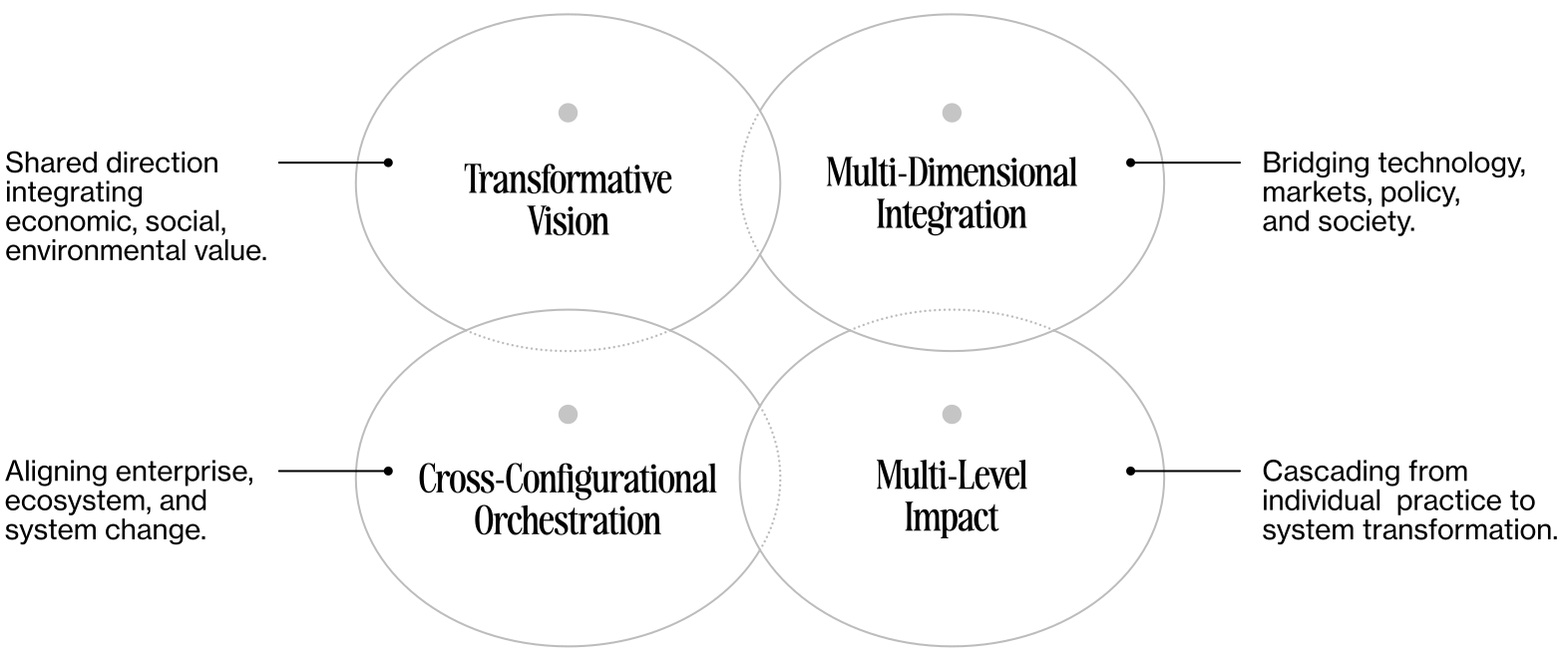
Cross-domain integration – linking technological, financial, social, and policy systems to unlock new value logics.
Multi-level orchestration – connecting micro practices, meso infrastructures, and macro systems into aligned pathways of change.
Distributed coordination – enabling collective innovation through shared frameworks rather than centralised control.
Transformative vision – aligning economic, social, technological and environmental outcomes within a coherent systems agenda.
Meta-innovation provides a structured approach for directing innovation at scale — not by creating isolated solutions, but by aligning and coordinating the conditions through which transformation occurs.
The Meta-Innovation Canvas supports this process by helping practitioners diagnose system readiness, design multi-actor collaborations, and orchestrate aligned action across boundaries.